New Hampshire Dog Registration Information
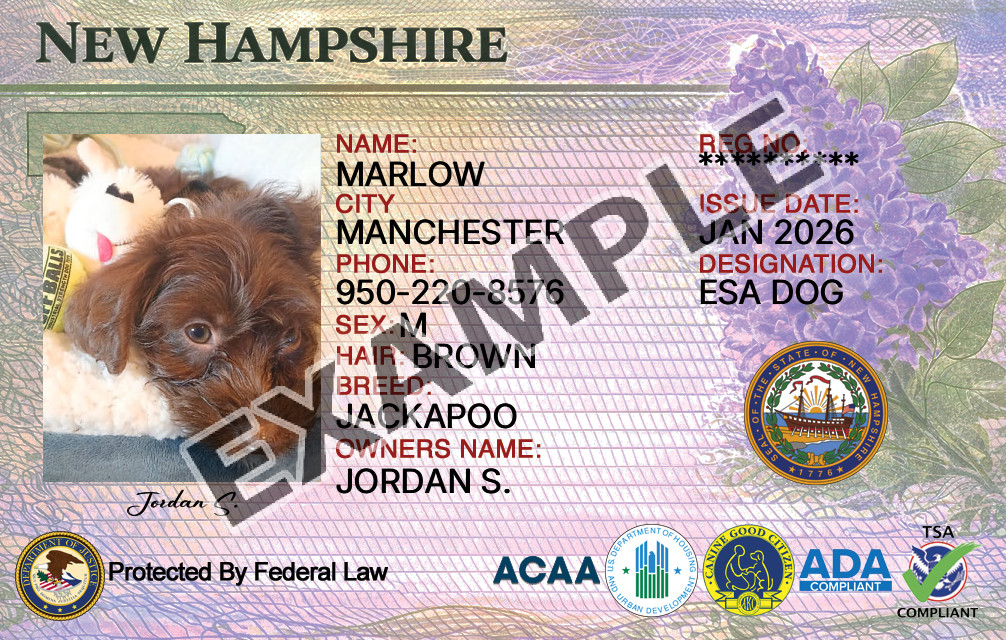
State Licensed, Service Dogs and Emotional Support Dogs in New Hampshire
If you are trying to figure out how to register my dog in new hampshire, the most important thing to know is that the answer is usually local. In New Hampshire, dog licensing is commonly administered by a city, county, town, municipal clerk, health office, or animal services agency rather than one universal statewide pet registry. That means the correct office usually depends on where your dog actually lives. Residents often search for terms like dog license in New Hampshire, animal control dog license New Hampshire, and where to register a dog in New Hampshire because the process can look different from one jurisdiction to the next. This page explains the local-first system, the rabies paperwork that is usually required, and the difference between ordinary licensing, service dog rights, and emotional support animal rules.
Overview of Dog Licensing in New Hampshire
Why local licensing matters
New Hampshire is a very local licensing state. Dog licenses are commonly issued by city and town clerks, and local law enforcement or dog officers may also be involved in enforcement. A dog license is normally an identification and compliance tool, not just a piece of paperwork. When a licensed dog gets loose, the tag and registration record can help animal control or a shelter trace the dog back to its owner more quickly. Local licensing also supports bite investigations, rabies control, shelter operations, and enforcement of leash or nuisance laws.
For most pet owners, the practical takeaway is simple: check the office that governs your residence, not the office where you adopted the dog or where your veterinarian is located. A dog may be required to be licensed where the owner resides even when veterinary care happens in a different city or county. Local governments may also set deadlines for new residents, puppies reaching licensing age, annual renewals, replacement tags, or late penalties.
What usually triggers licensing
New Hampshire law requires dogs over 4 months old to be licensed, generally through the town or city clerk. Even where the exact local deadline varies, the pattern is consistent: licensing typically begins once a dog is old enough to require rabies vaccination under the applicable rule and once the owner can provide current vaccination documentation. Some jurisdictions offer annual licenses only. Others offer multi-year tags if the rabies vaccine remains valid for the full license period.
Why a dog license is not the same as a breed permit or special status
A routine dog license is simply the ordinary local registration for a household dog. It does not by itself create any special disability-law status, travel rights, housing rights, or exemption from local animal rules. Likewise, calling a dog an emotional support animal or service dog does not automatically replace the normal local licensing process if the local ordinance still requires household dogs to be licensed.
Where to Register or License Your Dog in New Hampshire
Because licensing is often handled at the county, city, town, or municipal level, the examples below show several official offices in New Hampshire that residents may review when looking for the right local point of contact. These are examples of public offices and animal-control agencies, not third-party licensing vendors. Always confirm that the office listed below serves the exact place where your dog lives.
Manchester City Clerk
- Street Address: One City Hall Plaza
- City: Manchester
- State: NH
- ZIP: 03101
- Phone: 603-624-6455
- Email: Not listed on the official page reviewed.
- Office Hours: Hours were not clearly listed on the dog-license page reviewed.
Hampton Town Clerk
- Street Address: 100 Winnacunnet Rd.
- City: Hampton
- State: NH
- ZIP: 03842
- Phone: Not listed on the official page reviewed.
- Email: Not listed on the official page reviewed.
- Office Hours: Hours were not clearly listed on the page reviewed.
Exeter Town Clerk
- Street Address: 10 Front St.
- City: Exeter
- State: NH
- ZIP: 03833
- Phone: Not listed on the official page reviewed.
- Email: Not listed on the official page reviewed.
- Office Hours: Regular business hours referenced on the page; exact hours were not clearly listed in the snippet reviewed.
How Dog Licensing Works Locally in New Hampshire
Step 1: Find the office for your home address
The first step is matching your address to the correct licensing authority. In one part of New Hampshire, that may be a county animal services office. In another, it may be a city clerk, municipal health office, sheriff-supported animal control unit, or a local shelter acting under government authority. This is why people searching for where to register a dog in New Hampshire often get different answers depending on the city or county involved. The right answer is jurisdiction-specific.
Step 2: Gather rabies and owner records
New Hampshire licensing pages say proof of current rabies vaccination must be provided before a dog license is issued. In practical terms, most owners should expect to submit a current rabies certificate from a licensed veterinarian, the dog owner’s contact information, proof of residence in the local jurisdiction, and the licensing fee. Some offices also ask for proof of spay or neuter status if that affects the fee schedule. If your local office offers multiple license lengths, the rabies certificate may need to remain valid for the full term you want to buy.
Step 3: Apply, pay, and keep the tag current
Once the office confirms the paperwork, it generally issues a license record and a tag or other proof of compliance. Owners should attach the tag as required by local rule and renew it on time. If your dog moves, loses the tag, changes ownership, or experiences a lapse in vaccination, the local record may need to be updated. Keeping the local license current is part of routine responsible ownership and can make a major difference if the dog is ever found running at large.
Step 4: Understand the local enforcement side
Licensing is not just about fees. Local governments use licensing to support animal control, rabies investigations, shelter intake, impound procedures, and owner notification. If a dog bites someone, gets picked up as a stray, or is found without identification, a current license can make the follow-up process much easier. That is one reason searches for animal control dog license New Hampshire are common: animal control offices are often the agencies that enforce or administer the rules.
Service Dog Laws in New Hampshire
Service dog status comes from disability law, not from a pet registry
In New Hampshire, as in every state, the core public-access rules for service dogs come from disability law, especially the Americans with Disabilities Act. A service animal for ADA public-access purposes is generally a dog that is individually trained to do work or perform tasks for a person with a disability. The key legal issue is the dog’s task-based training and connection to the handler’s disability, not whether the dog has a badge, online certificate, special vest, or private registration.
A regular dog license does not create service dog rights
This distinction matters. A normal local pet license is still a local animal control document. It helps identify the dog and confirm compliance with vaccination and local rules. It does not turn a pet into a service animal. At the same time, many local governments still expect service dog owners to follow generally applicable public health and animal control requirements, such as rabies vaccination and standard licensing rules, unless a narrow local exemption applies. In other words, dog licensing and service dog rights are separate systems that can exist side by side.
What businesses and public places usually can ask
In public accommodations, staff generally may ask limited questions when the need for the dog is not obvious, such as whether the dog is required because of a disability and what work or task the dog has been trained to perform. They generally may not demand a special service-dog registration card, insist on online certification, or reject the dog solely because it lacks a vest. That is why it is important not to confuse a dog license in New Hampshire with legal service dog status. The two serve different purposes.
Emotional Support Animal Rules in New Hampshire
Emotional support animals are different from service dogs
An emotional support animal may be important to a person with a disability, but that does not automatically make the animal a service dog for public access. A dog whose only role is comfort, companionship, or emotional support usually does not qualify as a service animal under ADA public-access rules because the dog is not performing a trained disability-related task in the required way. This is one of the most misunderstood parts of pet law, and it often causes confusion for tenants, travelers, and business owners.
Housing questions are different from ordinary pet rules
Housing-related accommodation issues are often analyzed under fair housing rules rather than ordinary public-access rules. In that setting, both service animals and emotional support animals can matter, but the standards and documentation questions are different from a routine local pet license. A housing accommodation is not the same thing as a municipal license tag, and a housing letter does not replace local rabies or licensing duties if the local law still applies.
Why local licensing still matters for emotional support animals
Even if a dog functions as an emotional support animal in housing, the animal may still need to comply with local licensing, vaccination, leash, and nuisance rules. That means an ESA label does not normally excuse a resident from local registration requirements. The safest approach is to treat the local license, the rabies record, and any housing accommodation paperwork as separate items, each with its own purpose and issuing authority.
Frequently Asked Questions
What You May Need
- rabies vaccination proof
- identification
- proof of residency
- licensing fee
Register A Dog In Other New Hampshire Counties
Select your county from the dropdown below to get started with your dog’s ID card. Requirements and license designs may vary by county, so choose your location to see the correct options and complete your pup’s registration.
